Skip to content

OPENCENTRIC / COMPANY

Resources

Practical guidance for your next decision.

Understand the next step without learning every technical term. Start with your audience, desired outcome, and budget.

Planning questions

What is OpenCentric?

OpenCentric is developing a managed platform around a simple ownership model: you control your products, services, applications, and business logic; OpenCentric manages agreed infrastructure, runtime, and supported base images in your cloud account. Today, the workspace offers free guided planning, tool discovery, and downloadable drafts. Live management requires a separately agreed engagement.

Can I manage multiple tenants and applications?

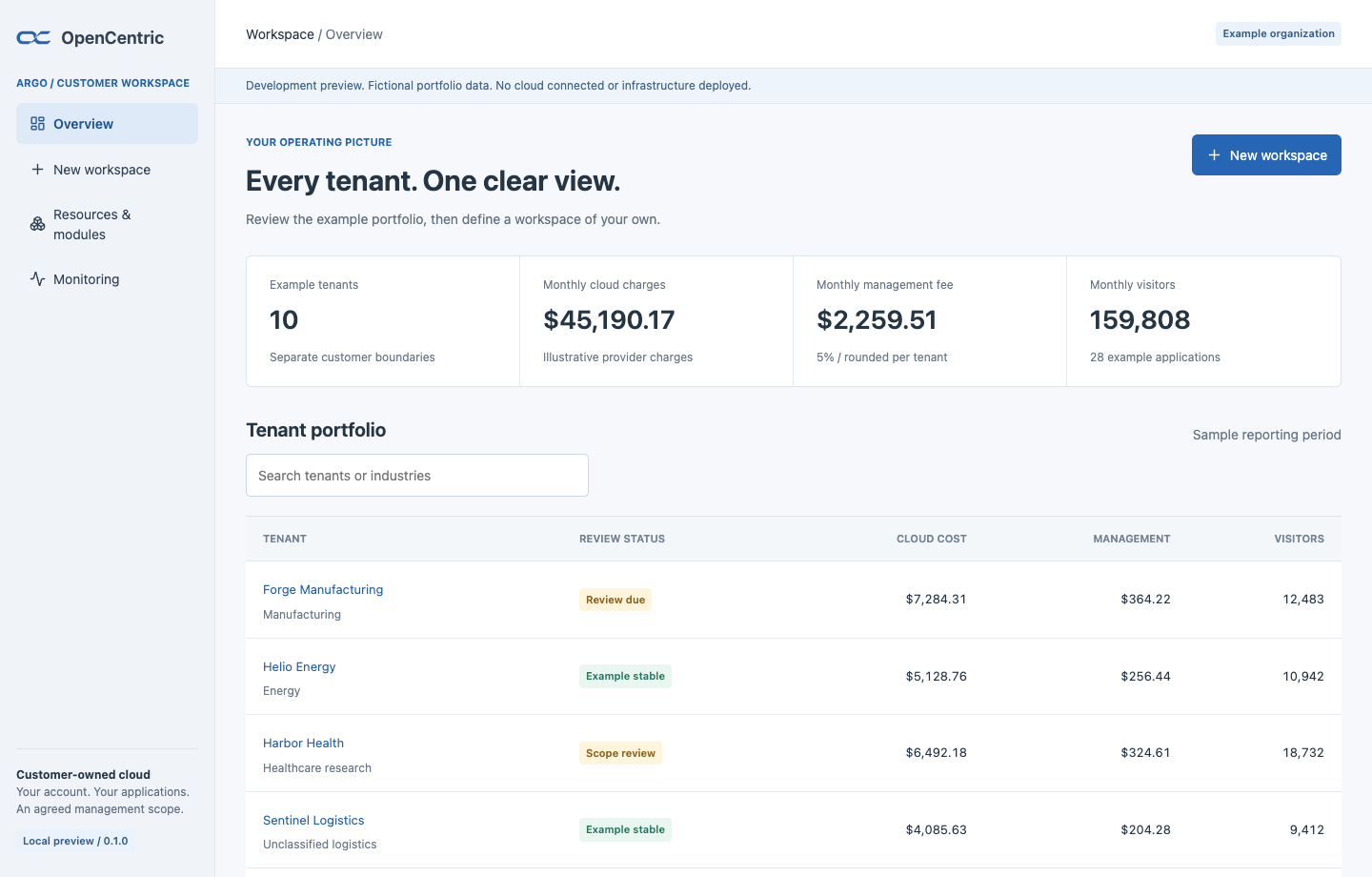
Yes. A tenant is a separate space for a customer or team, with one or more applications. You can plan these spaces today; the dashboard is not connected to deployed systems yet.

Can I use my own cloud environment?

Your cloud accounts and resources remain yours. You pay the CSP directly and delegate scoped access to OpenCentric. Billing visibility, environment isolation, state custody, and operating responsibilities are agreed before onboarding.

What happens after a thinking session?

Use the build plan to capture your applications, environments, requirements, and cost assumptions. Download a review packet. Team submission, automated provisioning, and live release execution are not connected in the current preview.

What belongs in the first build brief?

Include the intended users, first useful outcome, data sensitivity, access boundaries, integrations, approval decisions, deployment constraints, and budget. Identify what must work at launch and what can follow later.

How should I interpret costs and health?

Dashboard drafts use your cost estimates, not live cloud bills. Example data is explicitly labeled. No deployment means no measured health, compliance posture, utilization, or operational savings can be inferred.

Are ideas and build requests saved?

Not yet. Current planning data is held in the browser session and is not saved to an account. Download build packets before refreshing or leaving. Do not enter secrets or sensitive production records.

Need engineering support?

Studio can help scope architecture, application engineering, data, integrations, migration, and modernization. Start by describing the outcome and the decisions you need help making.

Explore Studio

Available in this workspace

Available now: free guided planning, tool discovery, cost illustrations, and draft exports. Drafts clear on reload. Live AI, accounts, publishing, payments, cloud connections, and managed operations are not connected. Managed services require an agreed engagement.

© 2026 OpenCentric™, Inc. All rights reserved.
YOUR OPENCENTRIC WORKSPACE

Everything underneath. Managed.

From your first website to connected products and embedded AI. You define the outcome; OpenCentric brings together and manages the foundation your solution needs.

CUSTOMER APPLICATION LAYER

Customer owned and operated

Your applications, added dependencies, data, business logic, configuration, tenants, users, and decisions.

MANAGED PLATFORM COMPONENTS

OpenCentric supplied and managed

Infrastructure, runtime, supported base images, delivery controls, and agreed operations. The boundary follows component ownership, not simply what is inside a container.

Managed throughout the lifecycle

Performance and reliability
Track health and response times. Adjust capacity to demand, within agreed cost and recovery limits.
Releases and configuration
Keep code and settings recorded. Test and approve updates, with a way back if a release fails.
Security and evidence
Find and prioritize weaknesses, verify fixes, and keep records for reviews.
Cost and resource efficiency
See where money goes. Review unused resources, resource sizes, and spending limits.

Capabilities as your needs grow

8 platform layers + continuous management

212 capability entries to plan from

This is a capability planning catalog, not a list of active or universally available services. Provider availability, integrations, service levels, and operating responsibilities are agreed for each solution before deployment.

Different missions. The same managed foundation.

Websites, SaaS, and commerce
Public sites, customer workspaces, payment links, and transparent product records.
Healthcare and life sciences
Sensitive data boundaries, interoperability, auditability, and clinical safety requirements.
Government and DoD
Approved environments, access restrictions, control evidence, and system-specific ATO planning.
Edge AI, robotics, and embedded systems
On-device inference, sensors, embedded vision and voice, device telemetry, firmware integration, and hardware validation, including limited-connectivity environments.
Space, aviation, and remote operations
Ground systems, mission data, simulation, and intermittent-connectivity requirements.

Regulated and safety-critical systems require workload-specific assessment, contracts, validation, and applicable approvals. Cloud availability does not establish compliance, an ATO, or hardware or flight certification.

Engineering and operating practices

Reference points for solution design and delivery. Applicable versions, controls, review cadence, and evidence requirements are agreed in each implementation plan.

NIST SSDF: secure software deliveryFinOps: usage and resource optimization

These references describe practices, not certifications held by OpenCentric.